
Logistics Launch Plan
Solara Skin Co. and Elena Rivera are fictional. Every number below is an illustration built on invented assumptions, not a Marcana quote and not a customer's data. Your plan is built from your facts.
Executive verdict
Your inventory is received and controlled in one U.S. location, and every channel is fed from that single record. Amazon gets a measured allocation for FBA, Shopify orders ship from the same stock, and a reserve covers delays and peaks.
When it fits: Two or more channels, a first production run you cannot afford to lock up, products that need lot or expiry control, or an Amazon launch whose sell-through is still unknown.
Use a hybrid model. Receive the full shipment at one U.S. operating location, reserve an initial Amazon allocation based on replenishment lead time, and fulfill Shopify orders from the same controlled inventory record. Do not send the entire first production run directly into FBA before sell-through, lot controls, packaging and return behavior are proven.
Confidence: moderate, pending packaging and lot-control validation
Facts reviewed and assumptions
| Products | 8 skincare and cosmetic SKUs, manufactured in Spain |
|---|---|
| Channels | Shopify DTC and Amazon U.S. |
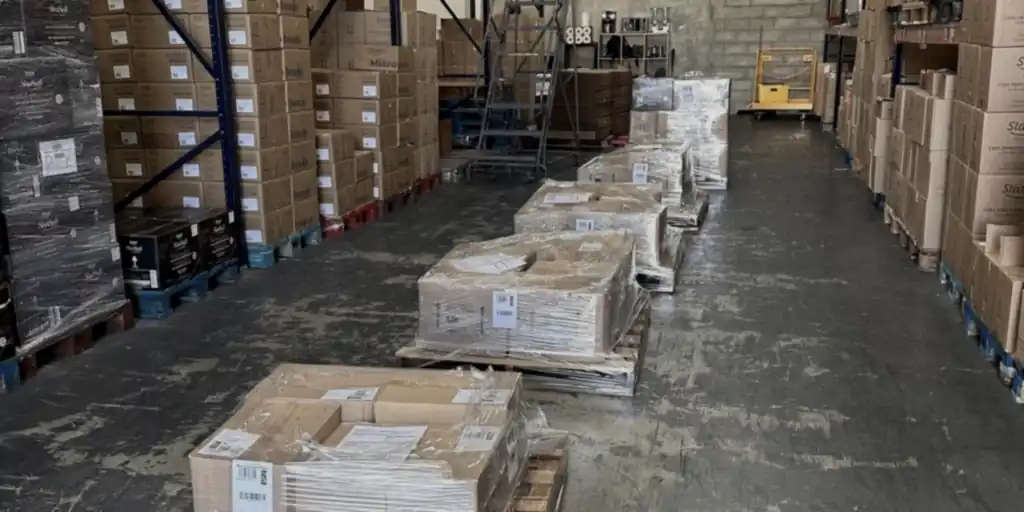
| First inbound | 6 pallets arriving in Miami in about 5 weeks |
| Expected volume | 800 DTC orders per month at launch, growing toward 1,500; periodic Amazon replenishment |
| Average order | 2 items, under 2 lb (to be validated against actual product weights) |
| Special handling | Cosmetic labeling, lot tracking, fragile secondary packaging, Amazon prep, returns disposition, bilingual support |
Assumptions that must be verified
- Retail packaging is final and survives a 3 ft drop test (must verify)
- No single SKU exceeds 12 oz or 8 in on its longest side (must verify)
- Amazon listing and FNSKU mapping are complete before the pallets land
- Customs broker is engaged and duties are pre-cleared
Recommended operating model
Hybrid model
- One inventory record avoids double-buying stock for Amazon and Shopify during the first cycle
- Lot and expiry control is easier to prove in one location before FBA commingling rules apply
- Reserve stock outside FBA protects Shopify service if Amazon receiving stalls
Alternatives considered
All-in FBALocks the whole first run inside Amazon before sell-through and return behavior are knownWhat this means
Fulfillment by Amazon: your whole inventory is shipped into Amazon's warehouses and Amazon stores, picks, packs and ships every order, including Shopify orders through Multi-Channel Fulfillment.
When it fits: Proven sellers where Amazon is the dominant channel, storage-friendly products and stable replenishment.
Why not here: Here it would lock the whole first run inside Amazon before sell-through, return behavior and labeling were proven, with no reserve if receiving stalled.
Self-fulfillment800 fragile cosmetic orders a month exceeds a one-person operation within weeksWhat this means
The founder or team stores inventory and packs and ships every order themselves, usually from a home, office or small unit.
When it fits: Under roughly 100 orders a month, simple non-fragile products, and a founder who still wants hands-on control of the unboxing.
Why not here: 800 fragile cosmetic orders a month exceed a one-person operation within weeks, and lot control by hand is where errors start.
Two separate 3PLsSplits a small first run and doubles onboarding and minimumsWhat this means
One provider handles Amazon prep and replenishment, another handles direct-to-consumer orders, each with its own inventory, minimums and onboarding.
When it fits: Large operations where each channel justifies its own specialist, or products that need different facilities (for example cold chain and ambient).
Why not here: It splits a small first run, doubles minimums and onboarding, and creates two inventory records to reconcile.
Inventory and channel allocation
| Channel | Role and inventory | Operating notes |
|---|---|---|
| Amazon U.S. | Launch allocation of roughly 30% of units per SKU, sized to two replenishment cycles | Replenish from the same reserve on a 21-day trigger |
| Shopify DTC | Fulfilled from the controlled reserve | Priority for new-SKU launches and bundles |
| Reserve | Remaining units held with lot tracking | Covers Amazon receiving delays and Shopify peaks |
Inbound and receiving plan
Before shipment
- Commercial invoice, packing list and HS codes matched to the eight SKUs
- Master-carton labels with SKU, lot and quantity, photographed before departure
- Advance shipment notice with pallet count and carton count
- Receiving appointment booked for the delivery window
At receiving
- Count and photograph every pallet and a sample of cartons on arrival
- Reconcile lot numbers against the packing list before put-away
- Flag damaged or short cartons within 24 hours
Exception plan
- Short shipment: hold Amazon allocation, protect Shopify first
- Damaged secondary packaging: quarantine the lot, decide relabel or dispose with the founder
Fulfillment cost model and sensitivity
Illustration only, built from Marcana's published planning rates and the fictional volume above. Carrier postage, storage beyond the included allowance, inbound receiving beyond the plan, special prep, materials, returns, Amazon prep, duties and taxes are not included.
Not included: carrier postage, additional storage, additional receiving, special prep, materials, returns, Amazon prep, duties or taxes.
Sensitivity
- Every 10% of orders that exceed 2 items adds roughly $0.35 per affected order
- Fragile packaging that requires a box instead of a mailer changes the materials line, not the pick-and-pack rate
- Amazon prep is billed per unit at published rates and depends on the launch allocation
Risk register
Complete preflight checklist
Legal and import
- Importer of record confirmed
- Commercial invoice and packing list
- Customs broker and freight forwarder coordinated
Product and marketplace
- Labeling and marketplace rules
- SKU, barcode and FNSKU mapping
- Master-carton and pallet data
- Lot and expiry controls
Receiving
- Receiving appointment and advance shipment notice
- Inspection, count and photo requirements
Systems and launch
- Shopify and Amazon integrations tested
- Packaging and insert approvals
- Carrier and service-level assumptions
- Returns and damaged-inventory disposition
- Allocation and replenishment triggers
- Test orders and launch-day monitoring
30-day action sequence
- Days 1 to 5Confirm labels against marketplace rules; drop-test packaging; finalize SKU and lot mapping
- Days 6 to 12Book the receiving appointment; send the ASN; photograph cartons at the factory
- Days 13 to 20Connect Shopify and Amazon; run test orders; approve inserts and packaging
- Days 21 to 28Receive, count and photograph; release the Amazon allocation; hold the reserve
- Days 29 to 30Launch monitoring: first 50 orders reviewed by hand; replenishment trigger set
Practical founder tips
- Do not let the factory choose final carton labels without validating the receiving and marketplace plan.
- Preserve sellable reserve stock outside FBA during the first demand cycle.
- Photograph master cartons and retail packaging before international departure.
- Test Shopify and marketplace SKUs against the warehouse SKU map before receiving.
- Establish who can approve relabeling, disposal and return disposition before launch.
- Build replenishment around total landed lead time, not only factory lead time.
Decisions that need a licensed or platform authority
| Cosmetic labeling and ingredient claims | Regulatory or labeling specialist |
|---|---|
| Duties, HS classification and importer obligations | Licensed customs broker |
| Amazon category approval and prep requirements | Amazon Seller Central guidance |
Next steps for Elena: confirm labeling, drop-test the packaging and book the receiving appointment. The optional Marcana fit assessment is answered separately and only if requested.
Terms used in this plan
Tap any term for a plain-language definition and when it fits.
Hybrid modelWhat this means
Your inventory is received and controlled in one U.S. location, and every channel is fed from that single record. Amazon gets a measured allocation for FBA, Shopify orders ship from the same stock, and a reserve covers delays and peaks.
When it fits: Two or more channels, a first production run you cannot afford to lock up, products that need lot or expiry control, or an Amazon launch whose sell-through is still unknown.
Why not here: Single-channel Amazon brands with proven velocity, or brands with too little stock to split.
All-in FBAWhat this means
Fulfillment by Amazon: your whole inventory is shipped into Amazon's warehouses and Amazon stores, picks, packs and ships every order, including Shopify orders through Multi-Channel Fulfillment.
When it fits: Proven sellers where Amazon is the dominant channel, storage-friendly products and stable replenishment.
Why not here: Here it would lock the whole first run inside Amazon before sell-through, return behavior and labeling were proven, with no reserve if receiving stalled.
Self-fulfillmentWhat this means
The founder or team stores inventory and packs and ships every order themselves, usually from a home, office or small unit.
When it fits: Under roughly 100 orders a month, simple non-fragile products, and a founder who still wants hands-on control of the unboxing.
Why not here: 800 fragile cosmetic orders a month exceed a one-person operation within weeks, and lot control by hand is where errors start.
Two separate 3PLsWhat this means
One provider handles Amazon prep and replenishment, another handles direct-to-consumer orders, each with its own inventory, minimums and onboarding.
When it fits: Large operations where each channel justifies its own specialist, or products that need different facilities (for example cold chain and ambient).
Why not here: It splits a small first run, doubles minimums and onboarding, and creates two inventory records to reconcile.
Reserve stockWhat this means
Sellable units deliberately held outside Amazon in a controlled location so that Shopify keeps shipping and Amazon can be replenished if its receiving is slow.
When it fits: Any launch with more than one channel or with an unknown Amazon receiving time.
Replenishment triggerWhat this means
The stock level or number of days of cover that automatically starts a new shipment to Amazon. Here it is set at 21 days of cover so a replenishment leaves before FBA runs out.
When it fits: Every FBA allocation; without one, replenishment happens after the stockout.
Lot and expiry controlWhat this means
Tracking which production batch each unit belongs to, from the master-carton label through put-away to the order, so a recall, an expiry date or a quality issue can be isolated to one lot.
When it fits: Cosmetics, supplements, food, anything with a shelf life or a regulator.
Advance shipment notice (ASN)What this means
The document sent to the warehouse before the freight arrives: pallet count, carton count, SKUs, quantities and lot numbers. It lets the receiving team book a dock appointment and check the shipment against a plan instead of guessing.
When it fits: Every inbound shipment; it is also what makes a short or damaged shipment provable.
FNSKUWhat this means
Amazon's own product identifier, printed on each unit that goes into FBA so Amazon can match it to your listing and not commingle it with another seller's stock.
When it fits: Any unit shipped to FBA; mapping it to your warehouse SKU before receiving avoids relabeling after put-away.
Pick and packWhat this means
The per-order handling fee: locating the items, packing them and handing the parcel to the carrier. Materials, postage and special prep are usually billed separately.
When it fits: It is the line that scales with orders, so it is the first number to verify in any quote.
Drop testWhat this means
Dropping a packed order from about 3 feet on corners and edges to see whether the retail packaging survives parcel handling. Failing it means a shipping box and void fill instead of a mailer.
When it fits: Glass, liquids, cosmetics, anything with a fragile secondary package.
Want this built for your own brand?
$149, no call required. Delivered in 2 business days or less after complete intake.